

Best Solar Gate Openers: Sizing and Battery Life for Bay Area Driveways
Which solar gate opener fits your gate, how big the panel and battery really need to be for a Bay Area winter, and what drains a solar system. Every spec here comes from the manufacturers' own manuals, so you can check each number.
 Livermore: a solar swing gate we installed
 GoogleVerified reviews
 YelpVerified reviews
 ThumbtackVerified reviews
A+BBB AccreditedA+ rated business
What Is a Solar Gate Opener?
A solar gate opener is a low-voltage DC gate operator that runs on batteries, while a solar panel recharges those batteries during the day. Because it needs no AC power at the gate, it suits long driveways, rural lots and gates far from the house. When it is sized for winter sun, it opens and closes like a wired gate.
- 1Best solar gate openers
- 2How the system works
- 3Sizing for Bay Area winter
- 4What drains the battery
- 5Battery life and fog
- 6DIY kit vs pro install
- 7What drives the cost
- 8Install with AGM
- 9FAQ
- 10Get an estimate
Why sizing matters more than brand
The catch is sizing. For example, a panel that keeps up in July can fall short in December, and every keypad, loop or intercom on the gate draws a little power around the clock. So the real question is less "which brand" and more "which operator, how many watts and how much battery for this gate."
So this guide answers that with LiftMaster's own solar sizing tables, the manuals for each model, and NREL sun data for San Jose, San Francisco and Concord. However, for the installation service itself, see our solar gate installation page.
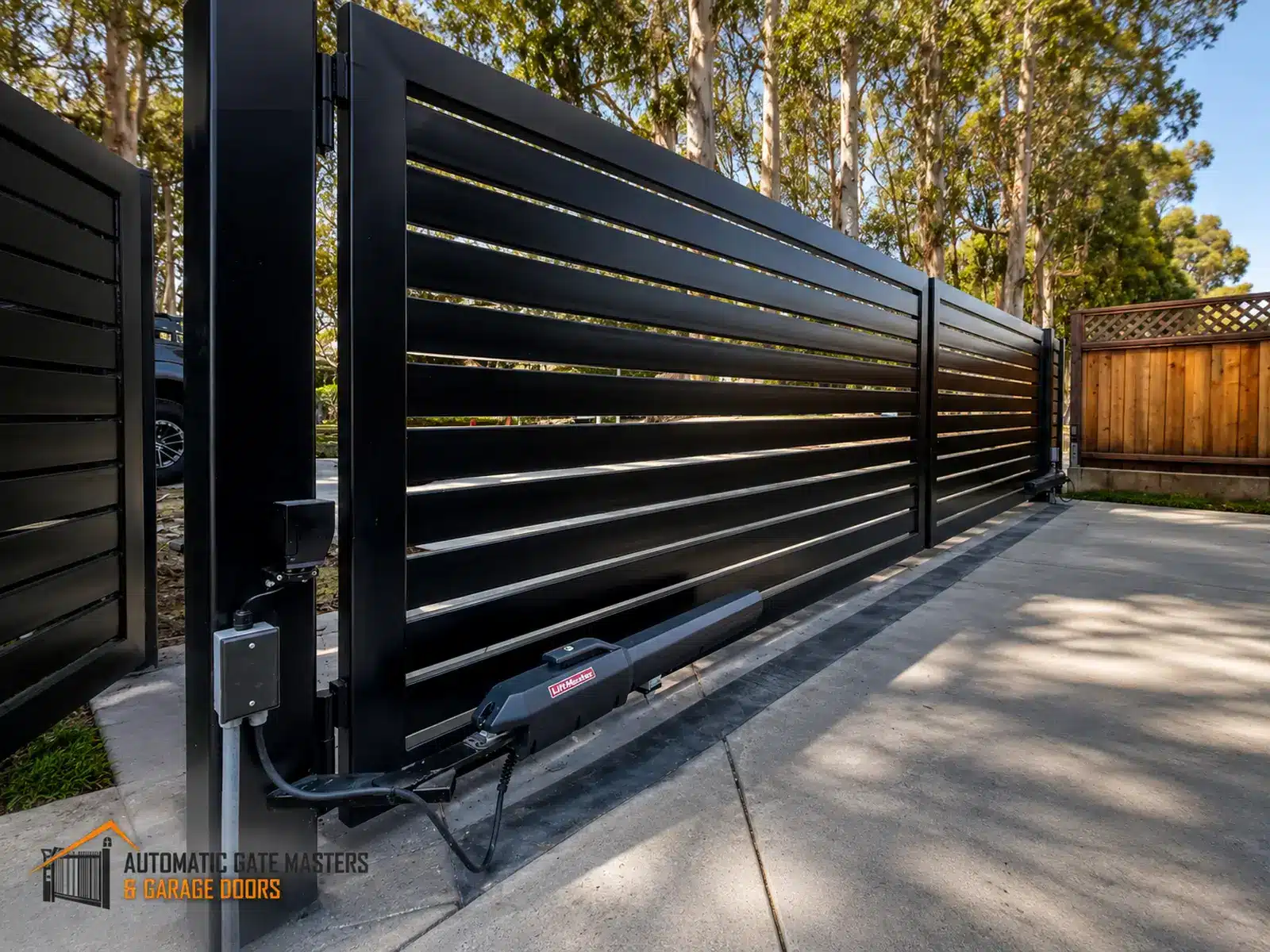
The Best Solar Gate Openers for Driveways
LiftMaster lists eight operators in its solar sizing guide, and in fact seven of them suit Bay Area driveways. The limits below come straight from each product guide and manual, so you can match the operator to the gate before thinking about panels.
Solar operator specs at a glance
| Operator | Gate type | Max gate (weight and length) | Duty rating | Solar input | Batteries included |
|---|---|---|---|---|---|
| LiftMaster LA412PKGUL | Residential swing (linear arm) | 850 lb at 10 ft, 550 lb at 16 ft | 100 cycles a day | 12V, solar only; panels in parallel | Two 7Ah |
| LiftMaster LA400PKGUL | Residential swing (linear arm) | 850 lb at 10 ft, 550 lb at 16 ft | 100 cycles a day | 24V; panels in series | Two 7Ah (33Ah option) |
| LiftMaster LA500PKGUL | Heavier swing (linear arm) | 1,600 lb at 8 ft, 800 lb at 16 ft, 600 lb at 18 ft | 300 cycles a day | 24V; panels in series | Two 7Ah (33Ah option) |
| LiftMaster RSW12UL | Residential swing | 1,000 lb at 6 ft, 600 lb at 12 ft, 400 lb at 16 ft | 250 cycles a day | 12V, up to 30W | One 7Ah |
| LiftMaster RSL12UL | Residential slide | 800 lb, up to 50 ft of travel | 120 cycles a day | 12V, up to 30W | One 7Ah |
| LiftMaster CSW24UL | Commercial swing | 1,200 lb at 12 ft, 800 lb at 16 ft, 600 lb at 18 ft | Continuous | 24V, up to 60W | Two 7Ah (33Ah option) |
| LiftMaster CSL24UL | Commercial slide | 1,500 lb, up to 50 ft of travel | Continuous | 24V, up to 60W | Two 7Ah |
Duty rating is the operator's mechanical limit. However, the cycles a day that solar can actually sustain come from the sizing tables further down, and they are usually lower.
How to pick, in plain terms
- Typical residential swing gate up to 16 feet: first, look at the LA412PKGUL or LA400PKGUL, since both carry 850 pounds at 10 feet.
- Long or heavy swing leaves: instead, choose the LA500PKGUL, rated up to 1,600 pounds at 8 feet, or the CSW24UL for commercial duty.
- Residential slide gate: meanwhile, the RSL12UL fits, rated for 800 pounds and 50 feet of travel.
- Heavy or commercial slide gate: finally, the CSL24UL is for 1,500 pounds.


Also, for the wider brand picture, compare operators on our automatic gate openers page, or read about the LiftMaster gate opener range. Also, if you are deciding between gate types first, our swing gates and sliding gates pages cover layouts and clearances.
How a Solar Gate Opener Works
Every solar gate system has the same four parts: the panel charges the batteries, the batteries run the operator, and the control board decides how much power everything else gets.
Charges the battery
LiftMaster panels come as the SP10W12V (10 watts) and SP20W12V (20 watts), so capacity can grow in steps. Also, they must face south with no shade all day, and they should be cleaned regularly.
Store the power
Most LiftMaster solar operators ship with 7Ah batteries, but many accept 33Ah batteries instead, which hold far more charge for cloudy weeks.
Spends the power
Even at rest the board draws a few milliamps, and each radio, loop detector or expansion board adds more. As a result, that standby draw sets how many cycles the panel can support.
Moves the gate
Solar operators run on low-voltage DC because batteries supply the power. In addition, LiftMaster wires 12 volt models with panels in parallel and 24 volt models with panels in series.
"If the panel(s) is not casting a shadow, the battery is not being charged." So a panel in shade at noon in winter is a panel that is not doing its job.
Sizing a Solar Gate Opener for a Bay Area Winter
LiftMaster sizes solar by four things: single or dual gate, cycles per day, the power each accessory draws and how much sun the region gets. Then its guide sorts regions into Zone 1 (6 hours of sunlight a day), Zone 2 (4 hours) and Zone 3 (2 hours), and its zone map shades most of California as its sunniest zone.
Bay Area sun hours by month
Winter is the real test, though. NREL's PVWatts data, for instance, shows how much the Bay Area's sun drops between summer and the shortest days:
Winter sun in three Bay Area cities
| Location (panel tilted 37 degrees) | January | December | July |
|---|---|---|---|
| San Jose | 3.7 | 4.0 | 7.3 |
| San Francisco | 3.9 | 3.7 | 6.4 |
| Concord | 3.6 | 3.7 | 7.4 |
These are average daily peak sun hours from NREL PVWatts v8 for a south-facing panel. However, on a flat panel, San Jose drops to about 2.2 hours in December.
LiftMaster's sunniest zone assumes 6 hours of sun a day, while PVWatts shows about 3.6 to 4.0 peak sun hours on a tilted Bay Area panel in December and January. So we leave margin for winter by adding panel wattage or 33Ah batteries, and we tilt the panel toward the low winter sun.
How standby draw changes the numbers
LiftMaster's own tables show how fast cycles a day fall as the board's standby draw rises. For instance, here is the LA412PKGUL, single gate, with its standard 7Ah batteries:
| Setup (cycles a day) | Zone 1 (6 h) | Zone 2 (4 h) | Zone 3 (2 h) |
|---|---|---|---|
| One 10W panel, 6 mA draw | 100 | 82 | 32 |
| One 10W panel, 30 mA draw | 100 | 58 | 14 |
| One 10W panel, 100 mA draw | 43 | 3 | Not supported |
| 20W of panels, 30 mA draw | 100 | 100 | 51 |
Source: LiftMaster Solar Gate Cycles Per Day Reference Guide (LMGTENCTSLGD 9/19). Still, the figures are approximations, and LiftMaster notes that local geography and weather may call for more panels.
In other words, a quiet single gate with one panel is easy, whereas a busy gate with a loop detector, a myQ link and a keypad needs more watts or more battery. Similarly, a dual gate needs more than a single one. For example, the same LA412PKGUL drops from 100 to 59 cycles a day in Zone 1 when it runs a wired pair of leaves.
What Drains a Solar Gate Battery
Gate motion uses power only for seconds at a time. By contrast, accessories draw power all day and all night, so they often decide whether a solar gate keeps up. These are LiftMaster's standby figures per feature, because accessories often decide the panel size:
| Feature | 24V boards (LA400, LA500, CSW24UL, CSL24UL) | 12V boards (LA412, RSW12UL, RSL12UL) |
|---|---|---|
| Main board, no radios | 2.7 mA | 4.2 mA |
| LiftMaster remotes learned | +1.0 mA | +1.5 mA |
| myQ or wireless dual gate | +2.4 mA | +3.9 mA |
| Each loop detector | +3.8 mA | +6.6 mA |
| Expansion board | +11.1 mA | +18.5 mA |
| Monitored wireless edge kit | +5.8 mA | +11 mA |
Source: LiftMaster Solar Gate Cycles Per Day Reference Guide. Moreover, LiftMaster notes that an unused expansion board can be unplugged to save its draw.
Not on solar
LiftMaster says photo eye heaters are not recommended in solar applications, and its solar requirements state that a heater cannot be used.
Power separately
Similarly, LiftMaster lists its MG1300 magnetic lock as not for use with solar applications, so it needs its own power supply.
Same principle
Likewise, Mighty Mule says continuous accessory draw above 20 mA is not recommended on its solar operators.
So before adding a keypad, intercom or app control to a solar gate, we total the standby draw and size the panel to match. Also, low-power or wireless accessories keep that budget small wherever possible.
Battery Life, Winter and Bay Area Fog
LiftMaster recommends replacing its operator batteries every 3 years, since batteries degrade with temperature and use. Then, when a battery runs low, the operator beeps three times on a command, so that sound is often the first sign. Also, our gate opener beep codes guide explains what each pattern means.
Battery size matters as much as age. For example, on a stand-alone system, LiftMaster rates the LA400PKGUL at 97 days of standby with two 7Ah batteries and 180 days with two 33Ah batteries. Likewise, the RSW12UL goes from 63 days with one 7Ah battery to 180 days with two 33Ah batteries.
Fog and shade
LiftMaster's manuals state that solar panels cannot be installed where heavy fog, snow or rain persists for long periods. In the Bay Area, for example, PVWatts shows San Francisco's July sun at about 6.4 hours on a tilted panel, compared with 7.3 in San Jose, which fits the summer fog pattern near the coast. Shade is the bigger local problem, however, because trees and buildings that clear the panel in summer can shade it once the winter sun sits lower.
"Solar gates stop working every winter."
A solar gate fails in winter when it was sized for summer. Because PVWatts puts San Jose's January sun at roughly half of July's, however, a system with winter margin, a tilted panel and no midday shade keeps running year round.
When a solar gate slows down
LiftMaster's troubleshooting list for a solar operator that is not getting enough cycles names four causes: too little panel wattage, too much accessory draw, old batteries and panels that are not getting enough sun. In practice, therefore, the fixes follow directly: add panels, cut accessory draw, replace batteries or move the panel. If your gate is already acting up, our gate repair team can test the battery and charging circuit.
Solar Gate Opener Kit vs Professional Installation
Box-store kits and professional operators both run on solar, but they are built for different gates. So here is how they compare on the published specs:
DIY solar kit (example: Mighty Mule MM371W)
- Rated for gates up to 16 feet and 550 pounds, so it suits lighter gates.
- However, it runs from a 12 volt automotive or marine battery that is not included.
- Mighty Mule's FM123 (10 watt) panel suits standard gates, while the FM125 (30 watt) is for heavy use or cloudy climates.
- Also, its winter chart lists about 8 to 54 cycles a day, depending on panel size and zone.
Professional operator (example: LiftMaster)
- Ratings from 550 pounds at 16 feet up to 1,600 pounds at 8 feet, plus slide gates up to 1,500 pounds.
- In addition, batteries are included, with 33Ah upgrades on many models.
- Then the system is sized with the manufacturer's zone and power-draw tables.
- Finally, monitored photo eyes or edges are wired in, as UL 325 requires.
Safety is the same with or without a power line
A solar operator is the same UL 325 listed operator as the wired version, so its safety rules do not change. For example, LiftMaster's CSW24UL manual requires at least two independent monitored entrapment protection devices at each entrapment zone. In addition, California Building Code Section 3110 requires automated vehicular gates to meet ASTM F2200 and use UL 325 listed operators. For details, our UL 325 and ASTM F2200 guide covers both.
Panel placement and wire runs
LiftMaster says panels must face south, clear of shade for the entire day. Besides that, wire length matters too: on the CSW24UL, 16 AWG wire reaches 235 feet for 20 watts of panels and 115 feet for 40 watts, while 10 AWG reaches 940 and 475 feet. So when the sunny spot is far from the gate, the wire size is part of the design.
Mighty Mule warns never to use the transformer and the solar panel at the same time, because it damages the control board. For brand-specific help, see our Mighty Mule troubleshooting guide.
What Drives the Cost of a Solar Gate Opener
Two solar gates can look alike and still price very differently, because the system is sized to the gate and the site. These are the factors that move the number:
The operator
A residential arm for a light swing gate costs less than a commercial swing or slide operator rated for a heavy gate.
Single or dual gate
Two leaves mean two operators, and LiftMaster's tables show a dual gate needs more solar capacity.
Panels and batteries
Winter margin comes from more panel wattage, 33Ah batteries or both, so this line moves the most.
Accessories
Also, keypads, loops, app control and intercoms add parts, and they also add standby draw that the panel must cover.
Panel location
Similarly, a sunny spot far from the gate needs a longer, heavier wire run and sometimes its own pole.
The gate itself
Finally, a gate that drags, sags or binds needs repair first, because a struggling gate drains a battery faster.
That is why we quote after a site visit. During that visit, moreover, we check winter shade, measure the gate and talk through traffic and accessories. Then you get a free written estimate before any work starts. Also, if the gate is near an existing power source, we will tell you whether a wired operator makes more sense.
Solar Gate Opener Installation with AGM
We install and service solar gate operators across the Bay Area from our San Jose office. This is how a project runs, from the first visit to the handoff.
Site visit
First of all, we check the gate, the traffic and where the sun falls in winter, not just today.
Sizing
Next, we pick the operator, then total the standby draw and size panels and batteries with winter margin.
Install and safety
Then we mount the panel facing south and wire monitored photo eyes or edges as UL 325 requires.
Test and handoff
Finally, we cycle the gate, confirm it reverses, and show you the manual release.

For the full service page, see our solar gate installation page. And if the power ever fails, here is how to open an electric gate manually.
Solar Gate Opener FAQ
What is the best solar gate opener for a driveway?
How many solar panels does a gate opener need?
Do solar gate openers work in winter in the Bay Area?
How long do solar gate opener batteries last?
Can I run an intercom or a magnetic lock on a solar gate?
Do solar gate openers need safety sensors?
How far can the solar panel be from the gate operator?
How much does a solar gate opener cost?
Sources
Specifically, the specs on this page were checked against these manufacturer documents and data sets in October 2026. Models and figures change, so for a specific gate, follow the current manual for your operator.
- LiftMaster, Solar Gate Cycles Per Day Reference Guide (LMGTENCTSLGD 9/19)
- LiftMaster, CSW24UL Installation Manual (01-39380B) and Product Guide (LMPAENPGCSW24)
- LiftMaster, CSL24UL Installation Manual (01-39381B)
- LiftMaster, RSW12UL Installation Manual (01-39378B) and Product Guide (LMPAENPGRSW12)
- LiftMaster, RSL12UL Installation Manual (01-39379B) and Product Guide (LMPAENPGRSL12)
- LiftMaster, LA412PKGUL, LA400UL and LA500UL Product Guides (LMPAENPGLA412, LMPAENPGLA400, LMPAENPGLA500)
- Mighty Mule, MM371W / MM372W Installation Manual (10022114)
- Mighty Mule, Solar Panel for Gates
- NREL PVWatts v8 calculator (now run by the National Laboratory of the Rockies)
- 2025 California Building Code, Section 3110, Automatic Vehicular Gates (Title 24, Part 2)
Planning a Solar Gate Opener?
Automatic Gate Masters & Garage Doors installs and services solar gate operators across the Bay Area. Before we quote, we look at your gate, your traffic and where the sun falls in winter.
So call, or send the form with a few details about your gate.
(650) 560-4646Tell us about your gate, and we will follow up to schedule a site visit. Bay Area addresses only.
