

Sliding Gate Openers: How to Choose the Right Slide Gate Operator
A buyer's guide to sliding gate openers for Bay Area driveways and commercial entrances. Sizing, power options, safety requirements, and a side-by-side look at the LiftMaster and Viking models we install.
CA Contractor Lic. #1060180. Serving Santa Clara, San Mateo, San Francisco, Alameda, Contra Costa and Marin counties.
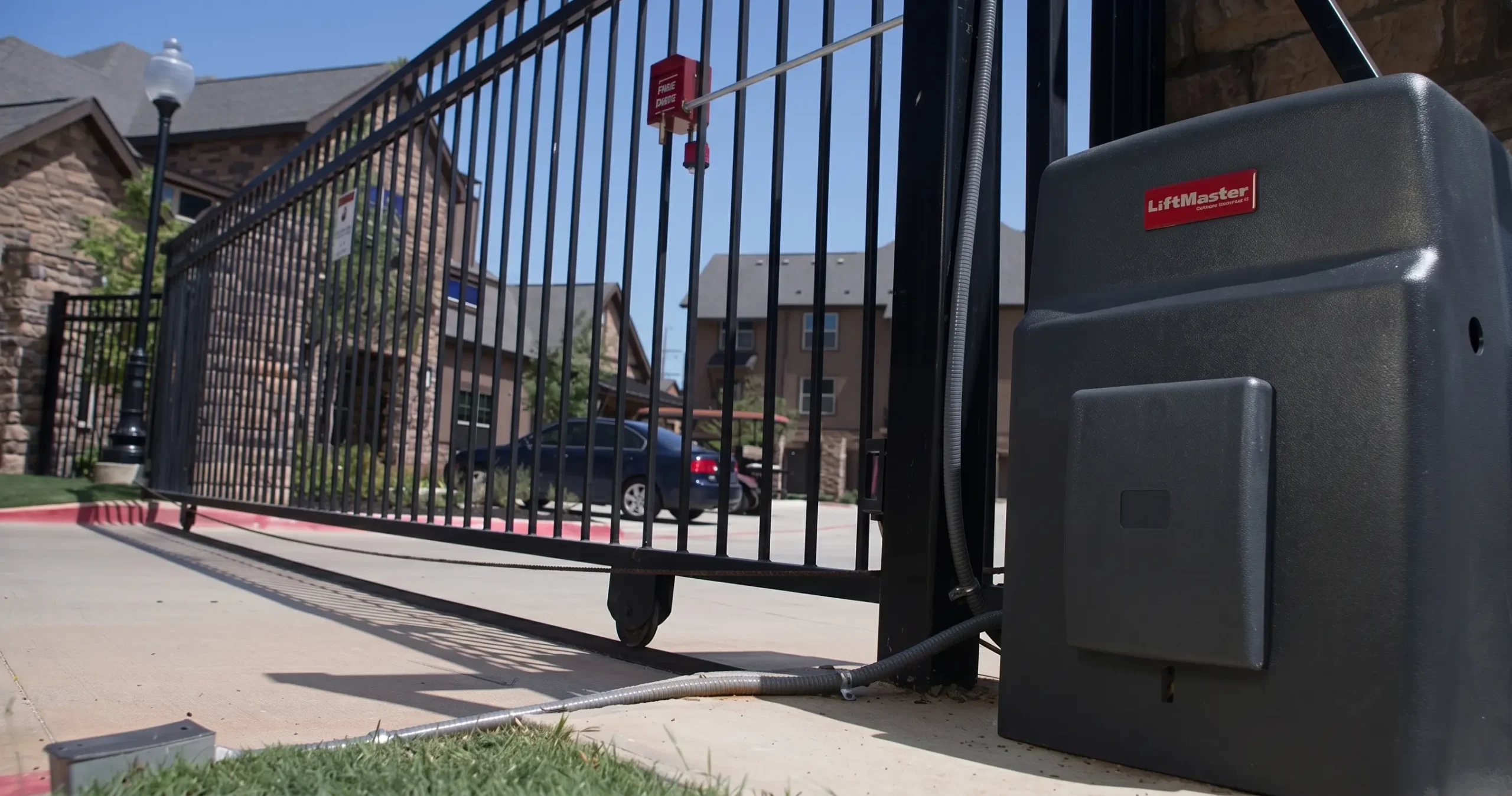
 LiftMaster CSL24UL, 24 VDC chain-drive slide operator
What a Sliding Gate Opener Does
A sliding gate opener, also called a slide gate operator, is the motor and control unit that moves a gate sideways along the fence line. Most residential and commercial units pull the gate with a chain. Because the gate travels parallel to the fence, slide openers suit sloped or short driveways where a swing gate cannot work.
Basically, choosing the right one comes down to five things: the gate's weight and length, how many times a day it cycles, the power you have at the gate, the safety devices the site needs, and the access control you want. In short, the operator has to match the gate, not the other way around. This guide walks through each decision, and then compares the specific models we install across the Bay Area.
How a Slide Gate Opener Works
Basically, every slide gate operator has the same four parts: a motor, a gear reducer that trades speed for pulling force, a drive that connects the reducer to the gate, and a control board that reads your remotes, keypads and safety devices. In practice, the differences between models are mostly in the drive type and in how the motor is powered.
Drive types
Chain drive
A #41 roller chain runs from one end of the gate, around the operator's sprocket, and back to the other end. The LiftMaster CSL24UL and SL3000UL both use a worm gear reducer running in an oil bath with a #41 chain, which is why they handle 50 ft gates. Because it is simple to service, chain drive is the standard for residential and commercial gates.
Source: LiftMaster CSL24UL and SL3000UL data sheets.
Hydraulic
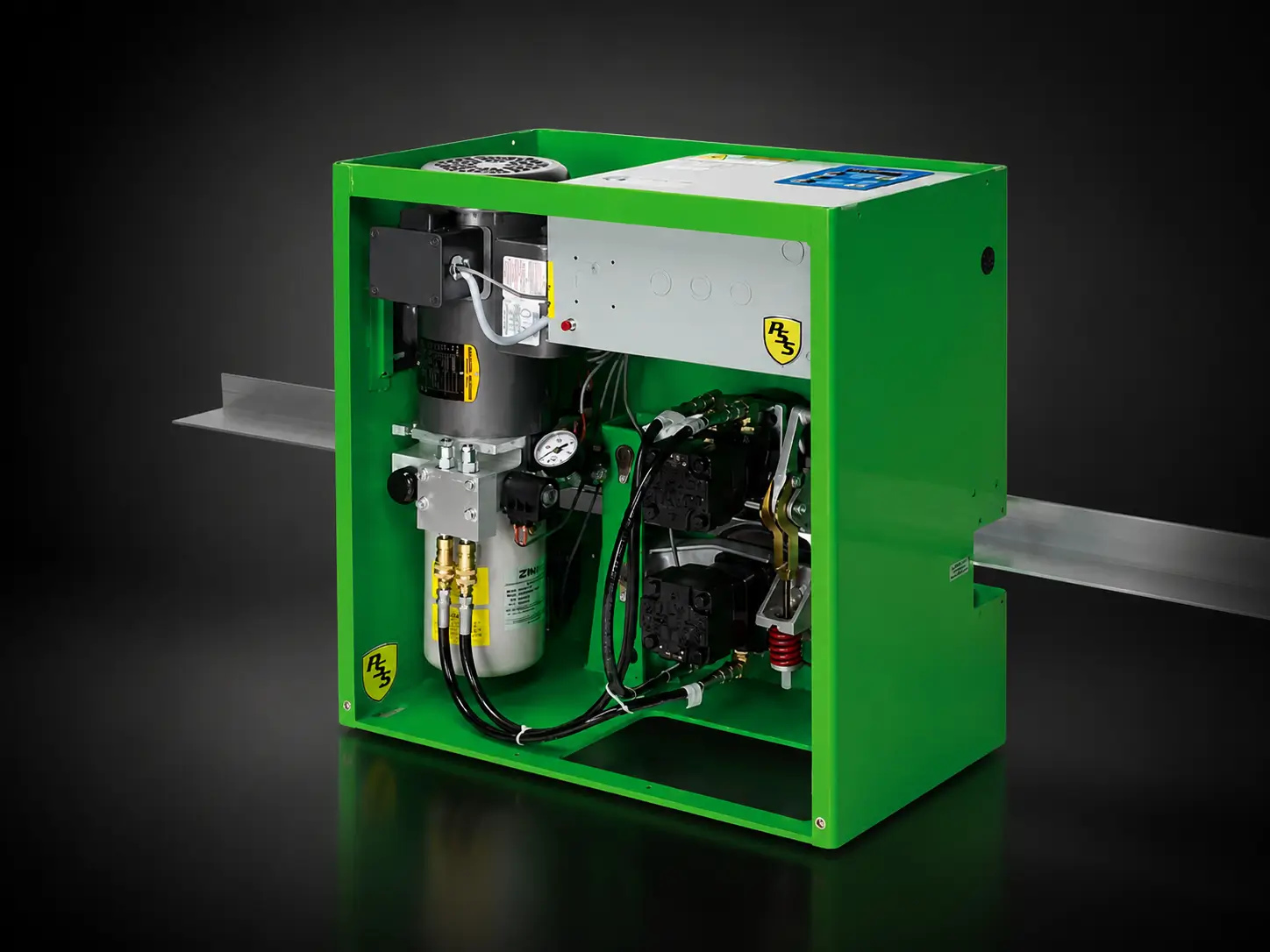
Hydraulic operators move the gate through drive wheels or a hydraulic motor. The HySecurity SlideDriver 40, for example, moves gates up to 4,000 lb at 1 ft per second with its drive wheels pressing on the gate rail. These units are built for industrial, parking and high-security sites, so they also need specialist service.
Source: HySecurity SlideDriver spec sheet.

Electromechanical 24 V
Many current operators, including the Viking L-3 and H-10 and the FAAC C721, use a 24 VDC motor fed from a transformer and battery. The low-voltage motor runs on the battery during an outage, and these are the models that make solar charging possible.
Source: Viking and FAAC USA product pages.
Three sliding gate styles, three operator conversations
The operator also has to suit the gate style. On top of that, the style decides how much side room the gate needs when it is open.
 V-track
 (rolling) gate
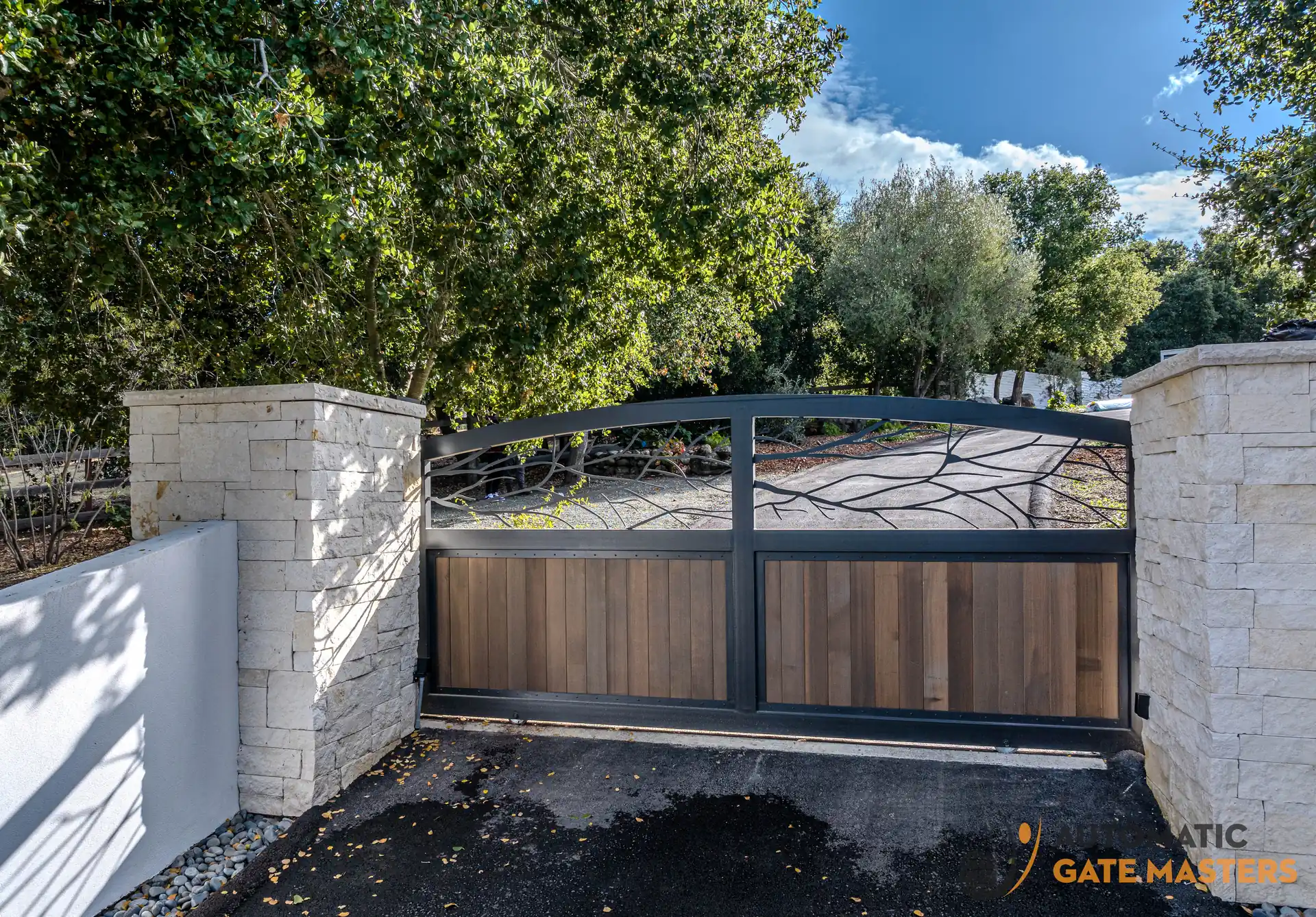
How it moves. First, wheels with a V groove ride on an inverted V steel track set across the driveway. This Los Altos Hills gate runs on a LiftMaster CSL24UL.
For the opener. Light rolling load, so a residential operator often does the job. However, the track must stay clear of leaves and gravel, or the operator reverses on the debris.
 Cantilever
 gate
How it moves. No ground track. Instead, the gate is built about half again as long as the opening and hangs from rollers on posts along the fence, like this San Jose slat gate.
For the opener. The counterbalance tail adds weight and length, so the operator is sized for the whole gate, not the opening. It also needs more run-back room.
 Telescoping
 gate
How it moves. Two or more panels stack as they open, so a 16 ft opening can clear with roughly half the run-back. This Palo Alto gate is a typical tight-lot example.
For the opener. The operator drives the lead panel and the linkage moves the rest, so panel weight and friction both count. See our sliding gate options.
See sliding gates in motion
Specifically, these two short clips from our own installs show how a telescoping gate stacks and clears a short run-back.
A custom telescoping gate opening on a lot with limited side room.
Panels nest as the gate travels, so the opening clears quickly.
Sizing a Sliding Gate Opener by Weight and Length
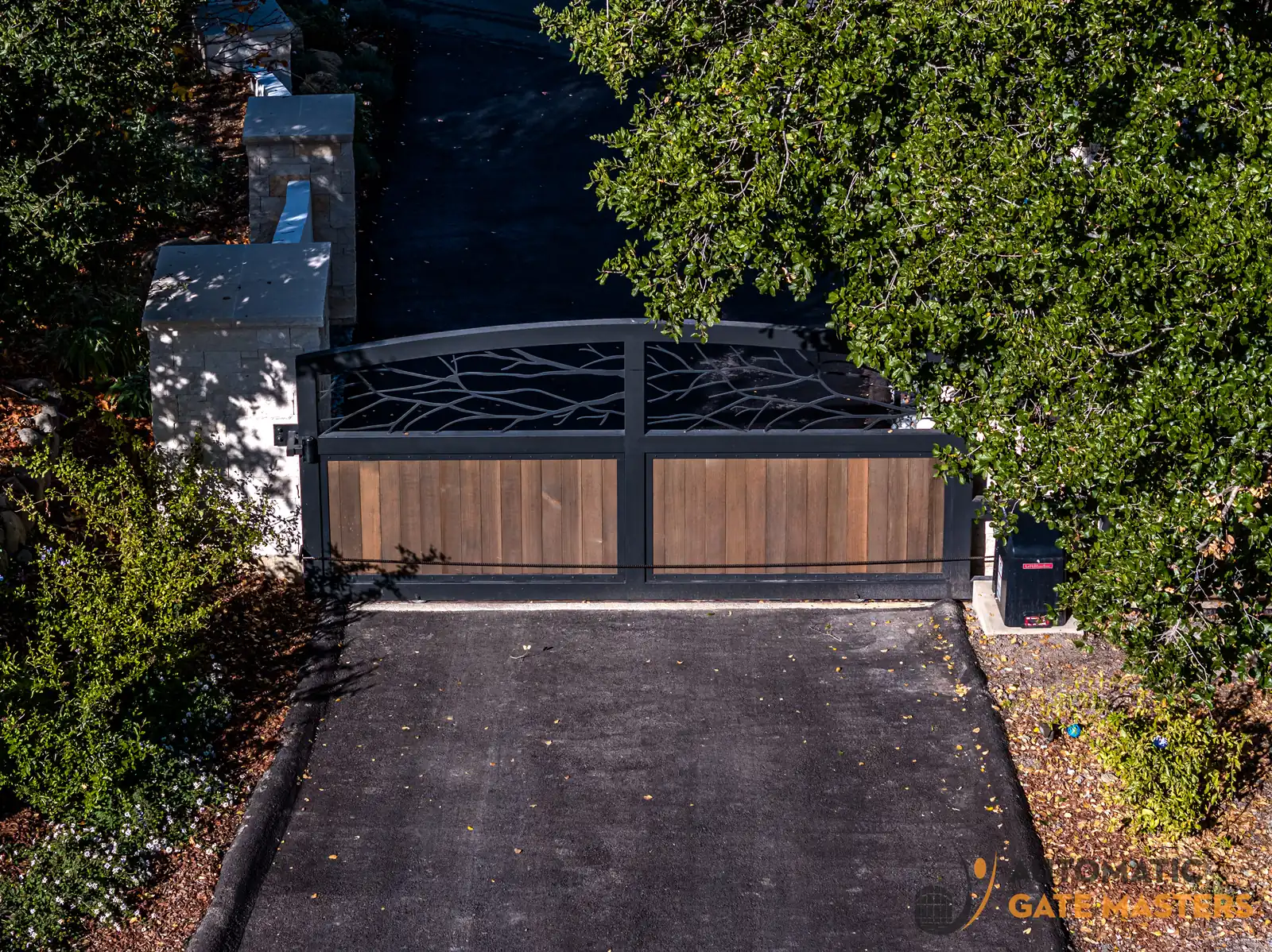
Manufacturers publish two ratings for every slide operator: a maximum gate weight and a maximum gate length. Both limits apply at the same time, so check each one. In practice we size above the bare gate weight, because the real load includes the counterbalance on a cantilever gate, friction in the track or rollers, wind on a solid infill panel, and any slope along the travel. The aerial view on the right also shows the third number that matters: run-back. A sliding gate needs clear room along the fence at least as long as the opening, and the operator sits at the end of that run.

Typical weight classes
| Gate | Typical weight | Operator class that usually fits |
|---|---|---|
| 12 to 16 ft steel picket V-track gate | Roughly 400 to 800 lb, so the lightest class | Residential 12 VDC, for example LiftMaster RSL12UL (800 lb, 25 ft) |
| 16 to 20 ft cantilever with privacy infill | Often 900 to 1,500 lb once the tail is included | Commercial 24 VDC, for example LiftMaster CSL24UL (1,500 lb, 50 ft) or Viking L-3 (1,600 lb, 60 ft) |
| Long or heavy commercial gates | 1,500 to 2,200 lb, especially with solid infill | LiftMaster SL3000UL 1 HP (2,000 lb, 50 ft) or Viking H-10 (2,200 lb, 75 ft) |
| Industrial, parking and secure sites | 2,200 lb and above, so beyond chain-drive ratings | Hydraulic, for example HySecurity SlideDriver 40 (4,000 lb) |
Weights above are typical ranges from our installations and are given for orientation only. Actual weight depends on the frame, infill and hardware, so we weigh or calculate each gate before we specify an operator. Ratings in the right-hand column come from the manufacturer pages listed in the references.
Cycles per day matter as much as weight
For example, a single-family driveway might open 10 to 20 times a day. A gated community entrance, an HOA, or a contractor yard can see hundreds of cycles. Residential operators are not built for that, so they wear out early when pushed. Commercial operators such as the CSL24UL and SL3000UL carry a continuous duty rating on their data sheets, which is what a shared entrance needs. Our industrial gate operator guide covers the models we install on those gates.
AC, Battery Backup or Solar
Power is the second big decision, because it changes which models are even on the list.
- First, it runs the gate during an outage, which matters during Bay Area public safety power shutoffs and winter storms.
- Soft start and stop on models such as the LiftMaster CSL24UL, so less shock on the gate and hardware.
- In addition, the same platform supports solar charging on models the manufacturer lists as solar-ready.
- Examples: LiftMaster RSL12UL (12 VDC) and CSL24UL (24 VDC), Viking L-3 and H-10 (24 VDC), FAAC C721 (24 V).
- Powered directly from 120 VAC. For example, the LiftMaster SL3000UL runs a 1/2 HP or 1 HP AC motor at 12 inches per second with a continuous duty rating.
- No battery is listed for the SL3000UL, so the gate stays where it is during an outage until it is released by hand.
- A good fit for sites with reliable power, a generator, or where the Elite heritage SL3000 is already installed and the owner wants a like-for-like replacement.
- Finally, mechanical limits rather than electronic ones on the SL3000UL, so limit adjustments are a technician task.
When solar makes sense
Solar avoids trenching power to a gate that sits far from the house, so it is a clean fit for low-cycle residential gates with an unshaded panel location. Both the RSL12UL and CSL24UL are listed as solar-ready by LiftMaster. Even so, a high-traffic gate, a shaded site, or a short winter day can outrun a small panel, so we size the panel and battery from your real cycle count. For the full picture, read our solar gate opener guide and the solar automatic gate systems page.

LiftMaster vs Viking: Sliding Gate Openers Compared
These are the two slide operator brands Automatic Gate Masters installs most often, so this is the comparison that actually comes up on site visits. Every number below comes from the manufacturer's data sheet or product page listed in the references. Where a manufacturer does not publish a figure, the cell says so rather than guessing.
Chain-drive operators with myQ app control, Security+ 2.0 remotes and a continuous duty rating on the commercial models. In addition, LiftMaster offers both DC battery-backup units and a traditional AC unit.
LiftMaster openers page24 VDC electromechanical operators with true battery backup as standard, push-button digital limits and the VFlex board with an LCD that shows diagnostics on the operator itself. Basically, built for longer and heavier gates.
Viking openers pageLiftMaster slide gate operators

RSL12UL
Residential and light commercial, especially V-track gates. Ships with a monitored photo eye and edge.
CSL24UL
High-traffic commercial, HOA entrances, and also larger homes. Continuous duty with electronic limits.
SL3000UL
Heavy commercial on 120 VAC, as well as like-for-like Elite SL3000 replacements. Mechanical limits and a 30:1 reducer.
Viking slide gate operators
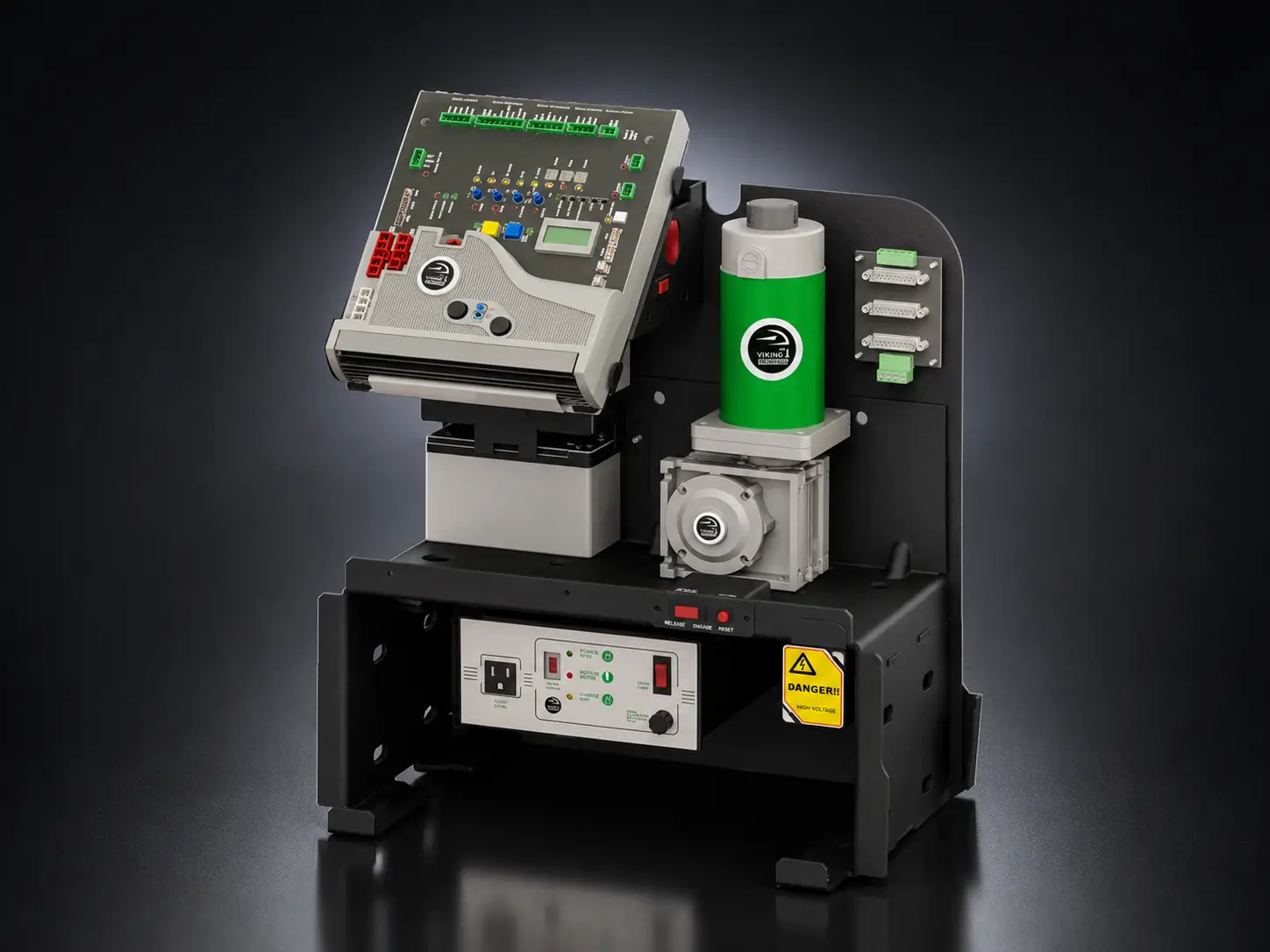
L-3
Residential and commercial. VFlex LCD board, removable power supply, and in addition a motor rated equivalent to 1/2 HP AC.
H-10
Long and heavy commercial gates, for example HOA entrances. Same VFlex board, and likewise a motor rated equivalent to 1 HP AC.
Side-by-side specifications
| LiftMaster | Viking | ||||
|---|---|---|---|---|---|
| Spec | RSL12UL | CSL24UL | SL3000UL | L-3 | H-10 |
| Max gate weight | 800 lb | 1,500 lb | 1,000 lb (1/2 HP) or 2,000 lb (1 HP) | 1,600 lb | 2,200 lb |
| Max gate length | 25 ft | 50 ft | 50 ft | 60 ft | 75 ft |
| Travel speed | Not published | 12 in/s | 12 in/s | 12 in/s | 12 in/s |
| Motor and power | 12 VDC | 24 VDC motor from 120/230 VAC | AC motor, 120 VAC | 24 VDC | 24 VDC |
| Battery backup | Standard | Standard | Not listed | Standard, true battery backup | Standard, true battery backup |
| Solar | Solar-ready | Solar-ready | No | Solar-compatible | Solar-compatible |
| Limits | Not published | Electronic | Mechanical | Digital, push-button | Digital, push-button |
| Smart and diagnostics | Security+ 2.0 receiver, also myQ | myQ, Security+ 2.0, continuous duty | Continuous duty, plus myQ | VFlex LCD diagnostics, built-in heater | VFlex LCD diagnostics, built-in heater |
| Typical use | Single-family V-track gate | HOA, commercial, larger homes | Heavy commercial, Elite SL3000 swap | Residential and commercial | Long or heavy commercial gates |
Sources: LiftMaster RSL12UL product page, CSL24UL and SL3000UL data sheets, Viking L-3 and H-10 product pages. Full links are in the references at the end of the guide.
Which one fits your gate
First, the RSL12UL is the budget pick with battery and solar built in. However, the L-3 gives you more headroom and on-board diagnostics for a little more.
Both are continuous duty with battery backup. Specifically, choose the H-10 when the gate is long or heavy, and the CSL24UL when myQ and Security+ 2.0 matter to the property.
The 1 HP SL3000UL moves 2,000 lb on 120 VAC and drops in where an Elite SL3000 lived. In this case you give up battery backup, so plan a manual release.
Need something heavier or hydraulic? We also install FAAC and HySecurity operators for industrial and high-security sites, and the automatic gate openers overview covers every brand we service.
Not sure which class your gate falls in? Send us the opening width, gate style and a photo. We will tell you which operators fit before anyone comes out.
UL 325 Safety on a Sliding Gate
A sliding gate creates pinch and crush points along the fence, at the posts and where the gate passes any fixed object. For that reason, the UL 325 standard, which gate operators in the United States are listed to, changed in 2016 to require two independent means of protection for every entrapment zone.
- Inherent sensing. First, the operator itself senses an obstruction and reverses. Every model in the comparison has it.
- Monitored external devices. Second, photo eyes and edge sensors covering the open and close zones, which the operator checks for presence and faults at least once per cycle. If a monitored device is missing or failed, the operator will not run in that direction.
- Matched accessories. Finally, LiftMaster ships the CSL24UL, RSL12UL and SL3000UL with a monitored retro-reflective photo eye and a monitored resistive edge, and states that the operator and the monitored devices form a compliant system only when used together.

Sources for this section: LiftMaster Builder Knowledge Center, UL 325 guidelines and DASMA Technical Data Sheet 353, UL 325 entrapment protection.
Remotes, Keypads and Access Control
The operator moves the gate, while access control decides who can tell it to. In practice, most sliding gate projects combine a few of these:

Remotes and keypads
Rolling-code remotes, a wireless keypad at the driveway, and also a free exit loop so cars leaving never have to stop. The Security+ 2.0 receiver on the LiftMaster CSL24UL and SL3000UL handles up to 50 remotes.

Video intercom
A video intercom at the gate lets you see and talk to a visitor from your phone, and then open the gate. We install DoorBird, CellGate, Ubiquiti and LiftMaster intercoms. See gate access control systems.

Smartphone control
LiftMaster operators with myQ connectivity report status and open from the app, and the Viking VFlex board shows diagnostics on an LCD. Our remote access guide compares the options.
What Drives the Cost of a Sliding Gate Opener Installation
We quote every project after a site visit, so this section explains where the money goes rather than quoting a price that may not fit your gate. In general, five things set the budget:
- Operator class. First, a residential 12 VDC unit is the low end, a commercial 24 VDC unit with battery backup sits in the middle, and hydraulic industrial operators cost the most.
- Power. Then there is power. Trenching conduit from the house or panel to the gate, or a solar kit sized for your cycles, is often the largest variable.
- Gate condition. A gate that binds, sags or has worn wheels loads the new operator from day one, so track or roller repair comes first.
- Safety devices. Monitored photo eyes and edges are required, and in addition longer gates or more entrapment zones need more of them.
- Access control. Finally, keypads, loops, intercoms and app connectivity each add hardware and wiring.
How a typical installation goes
- Site visit. We measure the opening and run-back, check the slope and the gate's weight and condition, and look at where power is.
- Written estimate. Then an itemized quote: operator, safety devices, access control and any gate or track work.
- Installation. After that, operator pad or post mount, chain or drive setup, limits, safety devices, then full-cycle testing with obstruction tests in both directions.
- Handover. Finally, remotes and codes programmed, the manual release demonstrated, and maintenance intervals explained.

Meanwhile, if your gate already has an operator that is failing, repair is sometimes the better call. Our LiftMaster gate repair and Bay Area gate repair pages explain how we decide, and the LiftMaster troubleshooting guide covers the safe checks you can do yourself first.
Sliding Gate Opener Installation in the Bay Area

Automatic Gate Masters & Garage Doors installs and services sliding gate openers in Santa Clara, San Mateo, San Francisco, Alameda, Contra Costa and Marin counties. Because we are an independent gate contractor, we recommend the operator that fits your gate rather than a single brand.
Call us, or send the form with your opening width and gate style. A photo of the gate also helps.
(650) 560-4646We will follow up to schedule a site visit. Bay Area addresses only.
Sliding Gate Opener FAQ
What size sliding gate opener do I need?
Do I need a battery backup on a sliding gate opener?
Can a sliding gate opener run on solar?
What is the difference between a chain-drive and a hydraulic slide gate opener?
How fast does a sliding gate opener open?
Are sliding gate openers safe for families and pets?
How much does a sliding gate opener cost installed in the Bay Area?
Sources
Specifications on this page were checked against these manufacturer documents in October 2026. Ratings change between revisions, so confirm against the current data sheet before ordering.
- LiftMaster CSL24UL Product Data Sheet
- Viking Access Systems, slide gate operators
- LiftMaster CSL24UL product page
- Viking L-3 slide gate operator
- LiftMaster RSL12UL product page
- FAAC USA, sliding gate automation
- LiftMaster SL3000UL Product Data Sheet
- HySecurity SlideDriver product page
- LiftMaster SL3000UL product page
- HySecurity SlideDriver spec sheet
- Viking H-10 slide gate operator
- LiftMaster Builder Knowledge Center, UL 325 guidelines
- DASMA Technical Data Sheet 353, UL 325 entrapment protection
Related: sliding gate installation, swing gates, driveway gates and custom gate design.
