

Corten Steel Gates: How Weathering Steel Works on a Bay Area Driveway
What Corten steel actually does outdoors, where it struggles, and how to keep it from staining your driveway. Plus what we learned building and automating a pre-rusted Corten gate in Fremont.
 Fremont, June 2026, install day
 GoogleVerified reviews
 YelpVerified reviews
 ThumbtackVerified reviews
A+BBB AccreditedA+ rated business
What Is a Corten Steel Gate?
A Corten steel gate is a gate built with weathering steel, a high-strength low-alloy steel with small additions of copper, chromium, nickel, silicon and phosphorus. Outdoors, it forms a protective rust-colored patina through repeated wet and dry cycles, so the panels are usually left unpainted.
COR-TEN is a U.S. Steel trademark, and SSAB sells it under license. In everyday use, though, people say Corten for any weathering steel, so this guide uses the word that way too.
Instead of paint, the steel itself turns a warm rust color, and that color deepens over the years. However, weathering steel only behaves well in the right conditions. On top of that, a driveway gate adds its own problems: runoff onto pavers, water trapped inside frames, wind on solid panels and a motor that has to move all of it.
So this guide covers each of those points, based on steel producer and engineering sources, plus a real Corten driveway gate we built and automated in Fremont in June 2026.
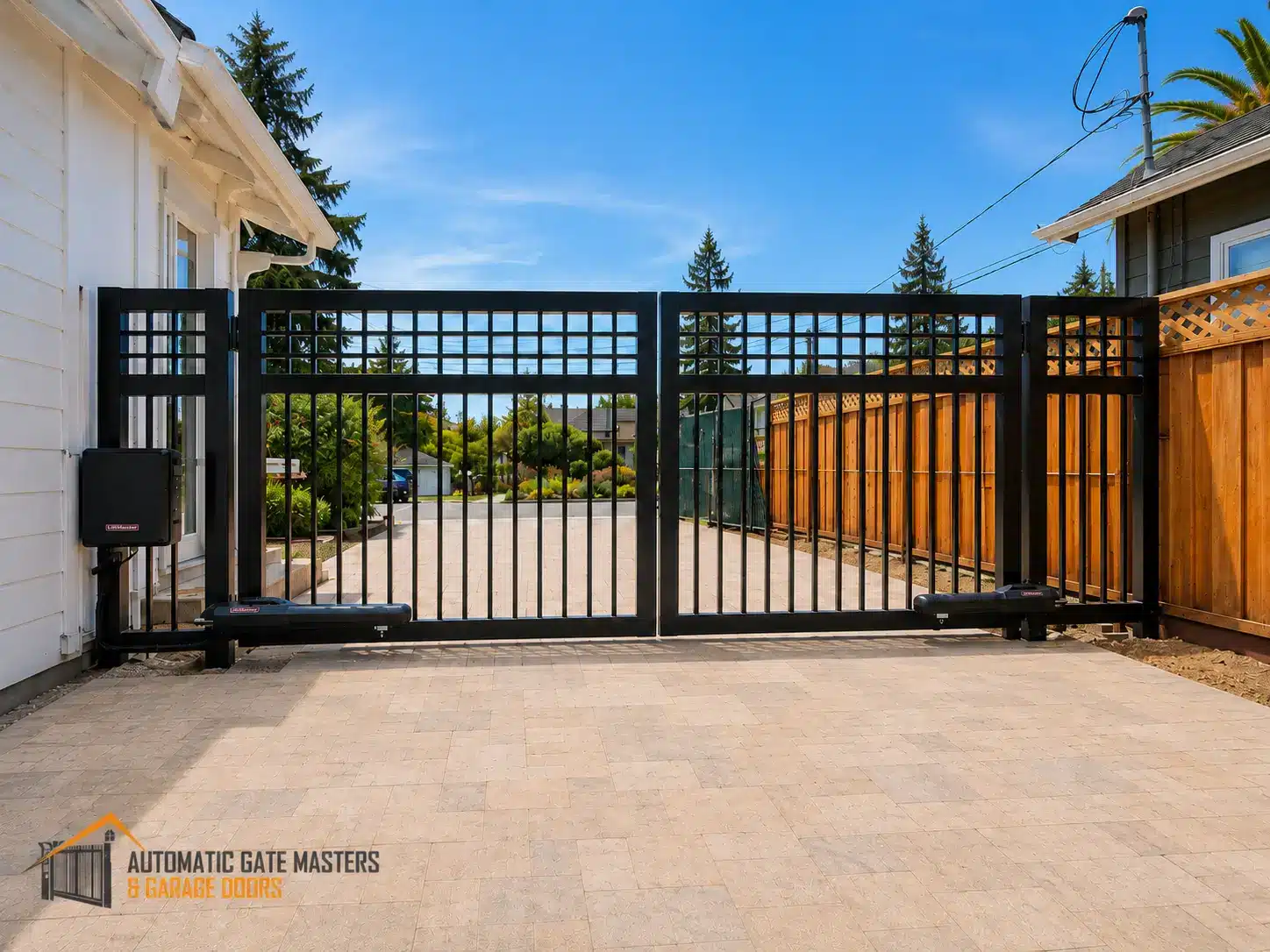
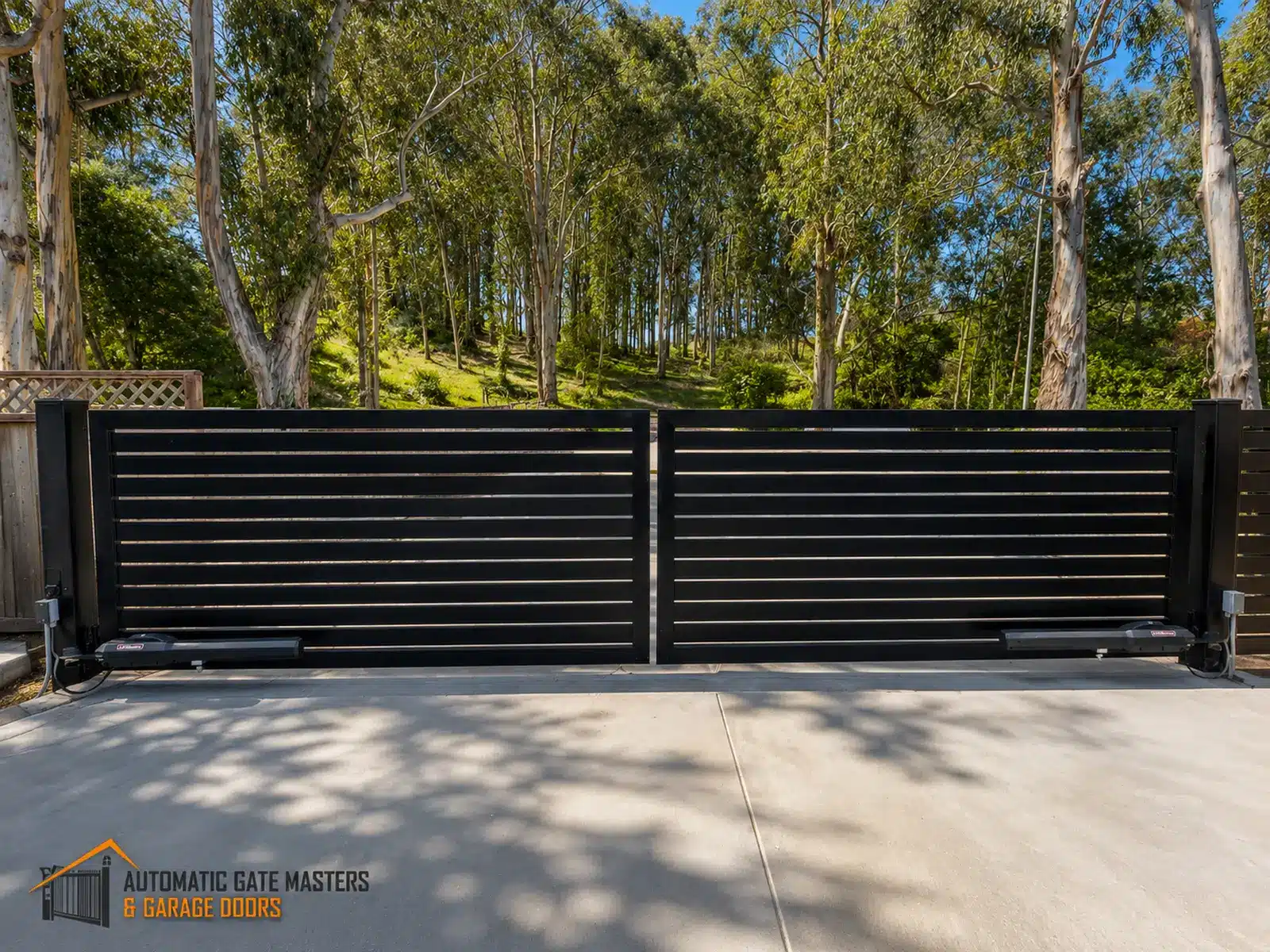
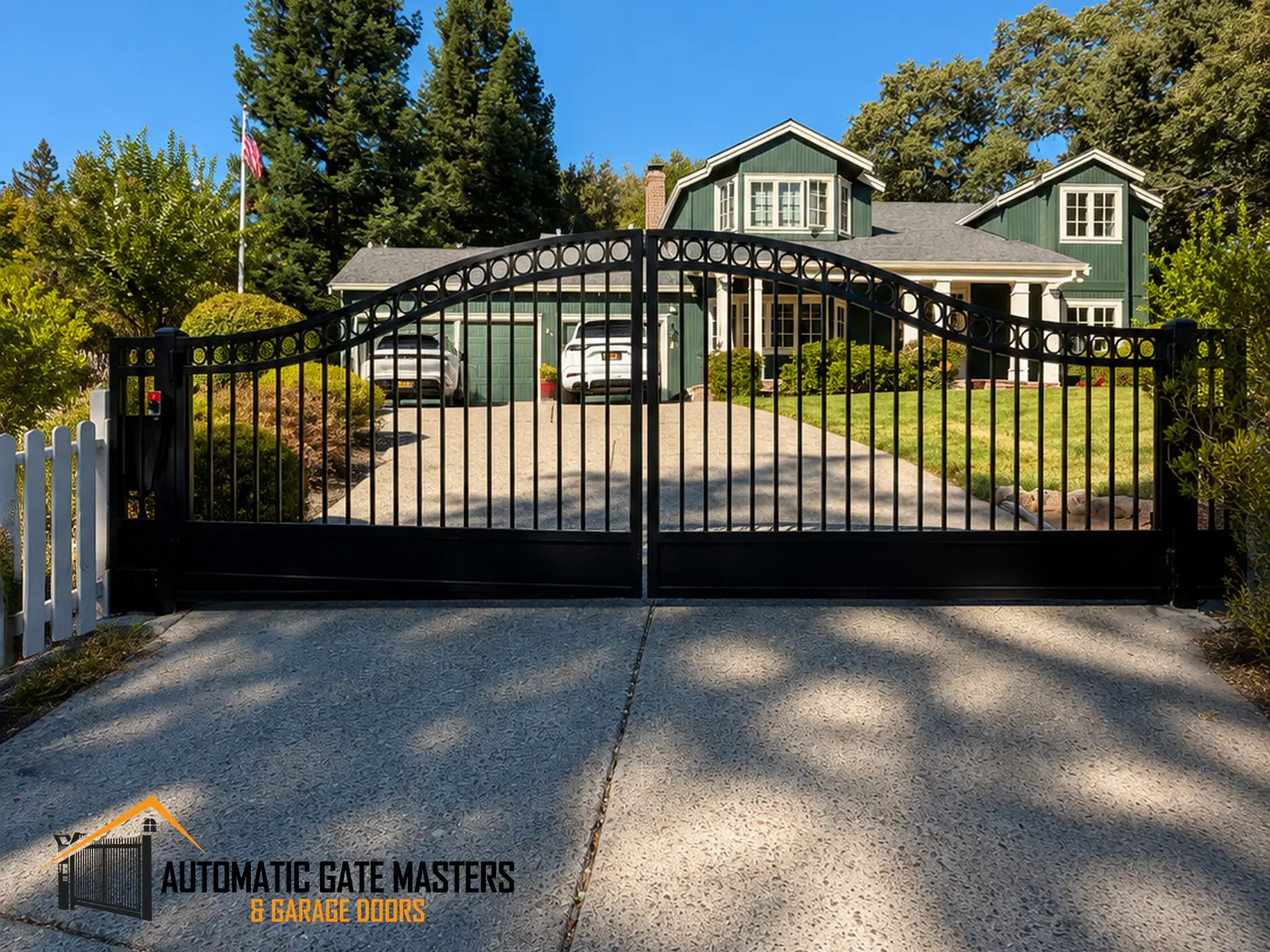
The Fremont Corten Driveway Gate
This custom dual swing driveway gate went in at a Fremont home in June 2026, and Jack managed the project from design through automation. Each leaf pairs a black steel tube frame with pre-rusted Corten steel sheet panels. In addition, matching fixed Corten side panels run on both sides of the opening, so the whole entrance reads as one continuous wall instead of a gate set between two fences.
On the inside face, flat-bar dividers split each leaf’s panel into four sections. Meanwhile, two LiftMaster LA500 swing operators, one per leaf, drive the gate. A LiftMaster control box is mounted on a post, and a photo eye watches the opening for safety.


Why pre-rusted panels in a black frame
First, pre-rusted panels arrive already orange. As a result, the gate looked finished on install day rather than starting from bare mill-finish steel and changing color through its first seasons in the driveway.
Second, the black frames give the design crisp edges. Because rust tones vary from panel to panel and with the light, a dark outline keeps the two leaves and the side panels reading as one composition.
Third, the split makes practical sense as well. In other words, the panels do the weathering, while the finished frame carries the hinges, operator brackets and hardware. That matters because, according to BlueScope, plain carbon steel parts next to weathering steel need protection, since unprotected carbon steel corrodes faster than patinated weathering steel.
Finally, both front photos above were taken on install day. So any difference between them comes from the light alone: warm orange in sun, deep brown under clouds. The patina itself will keep developing for years.
Also see two of our other steel builds, the Campbell steel grid gate and the Burlingame horizontal slat gate. For an existing gate that needs work instead, our Fremont gate repair page covers service in the area.
How the Corten Patina Forms
Weathering steel rusts like any steel at first. However, its alloy of copper, chromium, nickel, silicon and phosphorus changes what happens next. According to SSAB and BlueScope, three things build the protective patina: the alloy itself, repeated wet and dry cycles, and a suitable atmosphere with bold exposure to the weather.
During each wet spell, moisture drives corrosion. Then, as the surface dries, the oxide layer densifies. That is why regular cycling produces a more even patina, while steel that stays damp never forms a stable one.
How long the color change takes
SSAB says weathering steel typically takes 2 to 6 years to reach its final appearance. Sulfur in urban or industrial air speeds the process up and darkens it, whereas rural sites, according to KTA, patina more slowly. So treat any promise of a finished patina within a few months with caution.
Along the way, the color moves steadily. Early patina is bright orange, and BlueScope says it changes over time to “dark brown, almost purple.” Similarly, SSAB describes a shift from fresh orange-brown to light or dark brown.
Why the two faces of a gate can look different
BlueScope notes that boldly exposed surfaces patina faster, while sheltered ones change more slowly and with a rougher texture. On a driveway gate, therefore, the street face and the house face may not match, especially when one side sits under trees or eaves.
Also, protective oil on new cold-rolled sheet delays the patina, so it has to come off at installation. Mill scale, on the other hand, weathers off on its own, although grit blasting gives a more uniform look.
Where Corten Struggles
A weathering steel gate does not suit every site. In its technical advisory on uncoated weathering steel, the FHWA lists environments that call for caution:
- marine coastal areas, where salt settles on the steel;
- frequent high rainfall, high humidity or persistent fog;
- industrial areas with chemical fumes;
- and also spots exposed to deicing salt.
Over 60%
FHWA advises caution when the yearly average time of wetness exceeds 60 percent.
Site by site
According to BlueScope, salt deposition depends on wind direction, distance from the water and topography.
No stable patina
Because the patina needs drying time, steel that never dries out keeps corroding instead.
Likewise, ASTM G101 warns that atmospheric corrosion rates “can be much higher” when weathering steel stays wet for long periods or carries heavy salt contamination. In addition, BlueScope says weathering steel should not be buried in soil, and any buried portion needs a protective coating that extends above ground level. For a gate, that applies to posts and footings.
“Once Corten rusts over, you never have to think about it again.”
In a suitable site, uncoated weathering steel needs only nominal maintenance. In humid climates, though, KTA notes the patina may never stabilize. For example, Atlanta’s Omni Coliseum, opened in 1972, kept rusting, developed holes and was demolished about 25 years later.
What this means in the Bay Area
We found no Bay Area or California design guideline that addresses weathering steel. What the sources do support is a site-by-site call. Since FHWA flags persistent fog and marine exposure, a fog-belt hillside or a bayfront lot deserves a closer look before anyone orders Corten panels. By contrast, a sunny driveway that dries out between rains is closer to the conditions weathering steel needs.
Before you choose Corten: a quick site check
- Does the lot dry out?Ideally, the gate gets sun and air after each rain, so the wet and dry cycle can work.
- Fog, bay or ocean nearby?If so, we look at exposure and wind before recommending bare weathering steel.
- What sits under the gate line?Pavers, concrete and stone below the leaves need a runoff plan.
- Does local code require an open design?For instance, Woodside limits gates to 6 feet and requires them to be 40 percent open, which rules out a solid panel there.
Will a Corten Gate Stain Your Driveway?
Often, yes, at least while the patina forms. Runoff from weathering steel stains concrete, stone and brick, and BlueScope says that staining must be “closely considered and managed.” Famously, the U.S. Steel Tower in Pittsburgh stained sidewalks and nearby buildings during its initial weathering.
According to AISC, staining is most intense while the patina forms and much less once it stabilizes. Even so, the cheapest fix is planning for runoff before the gate goes in.
How we plan for runoff at the gate line
These steps apply BlueScope’s runoff guidance, which names drip plates, sloped surfaces, drains, landscaping that collects runoff and sealing of porous materials below.
- Drip edge on the top rail, so water falls clear of the panel faces instead of running down them.
- Gravel or planting strip under the gate line, which then catches runoff that would otherwise land on pavers.
- Sealed pavers or concrete below the gate, because a sealed surface can be cleaned later.
- Bottom rail kept clear of flatwork, which also helps the steel dry between rains.
- Sloped surfaces and planned drainage, so water never pools against the steel.
If stains do appear, FHWA lists cleaning with a commercial solvent and sealing the concrete with epoxy or a similar product as options. Besides that, AISC adds that stains can be blasted off or simply left to fade.
BlueScope also warns that contact with weathering steel can stain clothing. So when a gate sits next to a narrow walkway, a little extra clearance is worth planning in.
How We Build a Corten Gate
Most problems with weathering steel start in the details. Therefore, these are the points we design around, each one taken from steel producer or engineering guidance.
Tubes that drain
FHWA says small hollow boxes should be sealed or given weep holes, and NSBA notes that keeping water out of boxes often fails. So frame tubes get seal-welded ends or deliberate weep holes at their low points.
Matched filler
Per Hobart, small single-pass welds pick up alloy from the base metal. Larger multi-pass welds, however, need a low-alloy filler with about 1 percent nickel, or a weathering-grade filler, when color match matters.
304 stainless, isolated
BlueScope recommends grade 304 stainless steel screws with a rubber gasket, such as neoprene or EPDM, to isolate the metals and avoid crevices.
Never galvanized
Galvanized or cadmium-plated bolts are not generally recommended, because the coating wears quickly by galvanic action and can stain the steel.
No water traps
Overlapping surfaces trap moisture and cause rust-pack, so FHWA and BlueScope call for sealing or painting them. Likewise, ledges that collect leaves stay wet.
Clean steel
BlueScope asks that weathering steel stay free of oil, chalk, paint, gouges and concrete splatter. That is why panels stay protected while posts are set.
Fresh welds also start glossy grey against the matte brown panels. According to Hobart, weathering-grade fillers blend in most quickly, while BlueScope notes that on thinner plate the weld usually picks up enough alloy for a close color match. Meanwhile, ASTM A847 covers weathering-grade structural tubing, which is one option for frames that weather along with the panels.
For the design side, see our custom gate design page. Then, for more finished projects in steel, wood and iron, browse our automatic gate ideas gallery.
Automating a Heavy Corten Gate
Weathering steel is a low-alloy steel, so a Corten gate weighs about the same as an ordinary steel gate of identical design. For reference, steel plate weight tables put 11 gauge sheet at about 5.0 pounds per square foot. In other words, a solid sheet panel adds real weight on top of the frame, and the hinges, posts and operator all carry it.
Solid panels also catch wind. Specifically, a solid leaf acts like a sail, so operator choice and hinge and post design matter more than on an open picket gate. That is why we size the operator and hardware for the full leaf, wind included, rather than for its weight alone.
What the Fremont gate uses
Here, each leaf has its own LiftMaster LA500 swing operator, so each motor moves one leaf. A LiftMaster control box on a post runs the system, and a photo eye watches the opening. For more on these operators, see our LiftMaster gate opener page, or compare brands on our automatic gate openers page. Our swing gates page also covers hinge and clearance choices for dual swing layouts like this one.
Safety rules apply to every material
California Building Code Section 3110.2 requires gates intended for automation to comply with ASTM F2200, and Section 3110.3 requires vehicular gate openers to be listed to UL 325. Those rules apply whether the gate is Corten, wood or wrought iron. For example, an automated slide gate with a laser-cut Corten pattern still has to stop a 2 1/4 inch sphere up to 72 inches. Our UL 325 and ASTM F2200 guide covers the details.
Corten vs Powder-Coated Steel vs Wrought Iron vs Wood
Each material suits a different site. This comparison is qualitative and based on our own installs plus the sources above, so treat it as a starting point rather than a spec sheet.
| Topic | Corten steel | Powder-coated steel | Wrought iron | Wood |
|---|---|---|---|---|
| Look | Warm rust tones that deepen to dark brown | Any color, smooth and uniform | Classic ornamental, usually painted black | Natural grain, warm and organic |
| Finish over time | Patina keeps developing, typically 2 to 6 years per SSAB | Holds its color while the coating lasts | Holds while the paint lasts, then needs touch-up | Weathers and greys unless refinished |
| Maintenance | Nominal in a suitable site; also keep drains and debris traps clear | Ongoing coating care, especially at chips and scratches | Repainting and rust touch-up over time | Regular sealing or oiling |
| Staining risk | Real, mostly while the patina forms | Low while the coating is intact | Low while the paint is intact | None from rust runoff |
| Best site | Sunny, well-drained lots that dry between rains | Humid, foggy or salty sites, according to KTA | Traditional architecture and open picket designs | Privacy designs where a natural look fits |
In short, Corten rewards a site that dries out and a design that plans for runoff. For a humid or salty lot, on the other hand, coated steel gives a similar strength with a protective finish. To compare gate styles and layouts in more depth, see our driveway gates page and our automatic driveway gates guide.
Should You Seal Corten Steel?
Usually not, because any coating stops the surface oxidation that creates the patina. BlueScope is clear on that point. In other words, sealing a Corten gate largely gives up the reason to choose it.
There are exceptions, though. According to KTA, weathering steel should be coated where it stays constantly wet or meets chemicals such as deicing salt. A typical system is a zinc-rich or high-solids epoxy primer, an epoxy intermediate coat and a polyurethane or similar topcoat, often in brown to match. Likewise, KTA notes that in high-humidity settings, properly coated mild steel is often the better choice from the start.
Also keep in mind that blasting off graffiti removes the patina locally. It reforms over time, although the spot looks uneven in the meantime, according to BlueScope.
If your lot stays damp, sits in the fog or is close to salt water, ask us about a coated steel gate in a brown tone instead. That way, you get a similar warm look with a finish that protects the steel.
Corten Steel Gate FAQ
What is a Corten steel gate?
How long does a Corten gate take to reach its final color?
Will a Corten gate stain my driveway?
Is Corten a good choice near the bay or in fog?
Should I seal my Corten gate?
Can a Corten gate be automated?
How much maintenance does a Corten gate need?
Sources
Specifically, the facts on this page were checked against these documents in October 2026. Standards and product data change, so for a specific gate, follow the current manufacturer guidance and your city or county rules.
- FHWA Technical Advisory T 5140.22, Uncoated Weathering Steel in Structures
- BlueScope Steel, Technical Bulletin 26, REDCOR weathering steel (Rev. 7, 2019)
- SSAB, SSAB COR-TEN A for facades
- SSAB, Guide to weathering steel
- ASTM G101, Standard Guide for Estimating the Atmospheric Corrosion Resistance of Low-Alloy Steels
- ASTM A847/A847M, weathering-grade structural tubing
- Hobart Brothers, Weathering steel: taking the guesswork out of filler metal selection
- KTA-Tator, Weathering Steel: Use and Preparation When Left Uncoated and When Coated
- NSBA / Short Span Steel Bridge Alliance, Design, Detailing and Maintenance of Uncoated Weathering Steel
- Anver, steel plate weight guide
- ASTM F2200-24, Standard Specification for Automated Vehicular Gate Construction
- 2025 California Building Code, Section 3110, Automatic Vehicular Gates (Title 24, Part 2)
Planning a Corten Driveway Gate?
Automatic Gate Masters & Garage Doors designs, builds and automates custom driveway gates in steel, wood and iron across the Bay Area. Before we quote a Corten gate, we look at your site, the paving under the gate line and how the gate will be automated.
Then call, or send the form with a few details about your driveway.
(650) 560-4646Tell us about your driveway, and we will follow up to schedule a site visit. Bay Area addresses only.
